


Chapter 01 / 06
Compare responsibilities before features
A founder with no technical team and standard fulfillment has different constraints from a retailer with an existing WordPress operation or a company with a specialized ordering workflow. Ask who will own updates, integrations, product data and incident response.
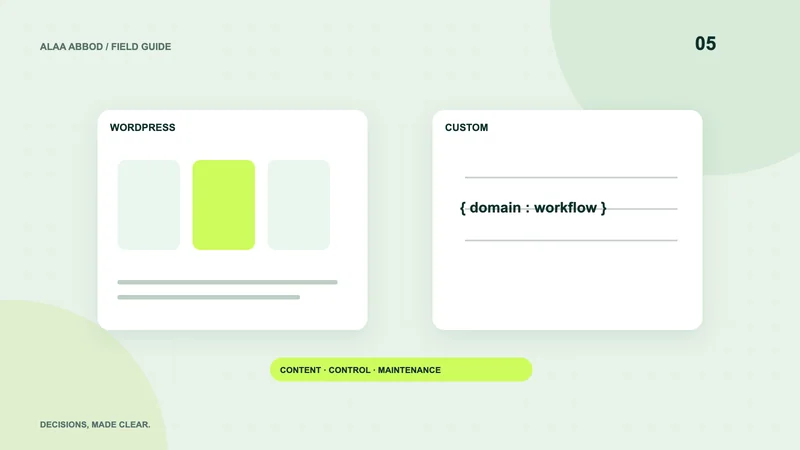
Shopify manages the platform infrastructure while the merchant still configures products, apps, access and business processes. WooCommerce puts more hosting and plugin operation under your control. Custom development lets you define the product but also leaves you responsible for its delivery and ongoing reliability.
| Dimension | Shopify | WooCommerce | Custom |
|---|---|---|---|
| Infrastructure | Managed platform | Chosen hosting and maintenance | Your application and infrastructure |
| Content | Platform publishing tools | WordPress content ecosystem | Designed editorial system |
| Extension | Apps and platform APIs | Plugins and custom WordPress code | Purpose-built integrations |
| Change boundaries | Plan and API constraints | Plugin and hosting compatibility | Engineering capacity and architecture |
| Best starting question | Does standard commerce fit? | Does WordPress ownership help? | What valuable requirement needs custom code? |
Chapter 02 / 06
Read the real price terms
At the research date, Shopify’s German page showed Basic at 27 EUR per month with annual billing and 36 EUR with monthly billing. Treat that as a dated plan reference, not a full shop budget. Check current regional terms, tax treatment, apps, payment mix and additional transaction charges before signing.
WooCommerce’s core is free and open source; hosting, extensions, development and maintenance still cost money. Custom software has no single subscription price, but engineering and operations do not disappear. Build a twelve-month cost model using the same expected orders and support needs for every option.
Chapter 03 / 06
Test the exception that could decide the platform
Write the hardest real purchase: a customer-specific price, a subscription change, a product configuration, a regional delivery restriction or an inventory update from another system. Attempt that workflow with the proposed plan and extensions before designing the entire storefront.
Record what is native, what an extension owns and what requires custom code. Check the extension’s update and support policy and whether your data can be exported. Avoid assembling several apps that each hold a conflicting version of the same commercial rule.
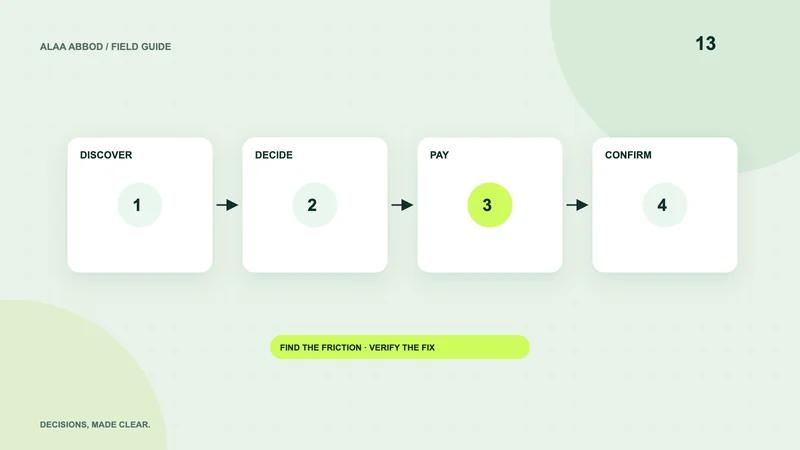
- Journey Describe the hardest actual order.
- Fit Implement it in a bounded proof.
- Responsibility Assign every rule to a system and owner.
- Exit Verify data export, account access and migration constraints.
Chapter 04 / 06
Custom code is an investment decision
A custom shop can make sense for a genuinely differentiated buying workflow or a deeply specialized system integration. It is less persuasive when the only requirement is a different button style. Familiar patterns help customers buy; unusual behavior needs evidence of value.
Estimate both initial delivery and the cost of changing payment, tax, shipping and security dependencies. Consider a standard commerce core with a tailored interface or integration first. This can isolate the unique part without rebuilding every operational capability.
Chapter 05 / 06
SEO and accessibility depend on implementation
Any option can be configured poorly. Check indexable product and category URLs, redirects for replaced products, meaningful content, structured product data where truthful and a usable mobile checkout. A platform name alone does not ensure search performance.
Likewise, evaluate actual controls, error messages, keyboard use and contrast rather than a theme’s marketing label. For a German business, assess applicable accessibility and privacy obligations with the relevant context. A technical implementation is not a blanket compliance certificate.
Chapter 06 / 06
Write the decision as a short operating agreement
Name the chosen platform, its decisive requirement, recurring costs, excluded features, account owner and maintenance owner. Include the proof results and a complete test order. This gives the business a decision it can revisit when volumes or workflows change.
Keep the final choice proportionate. A small team should not inherit custom infrastructure it cannot maintain. A specialized business should not spend years fighting a platform boundary that was visible in the first proof. The right choice is the one that makes the required journey reliable within your resources.
For implementation: Explore the relevant service.