



Chapter 01 / 06
Use a funnel that matches actual events
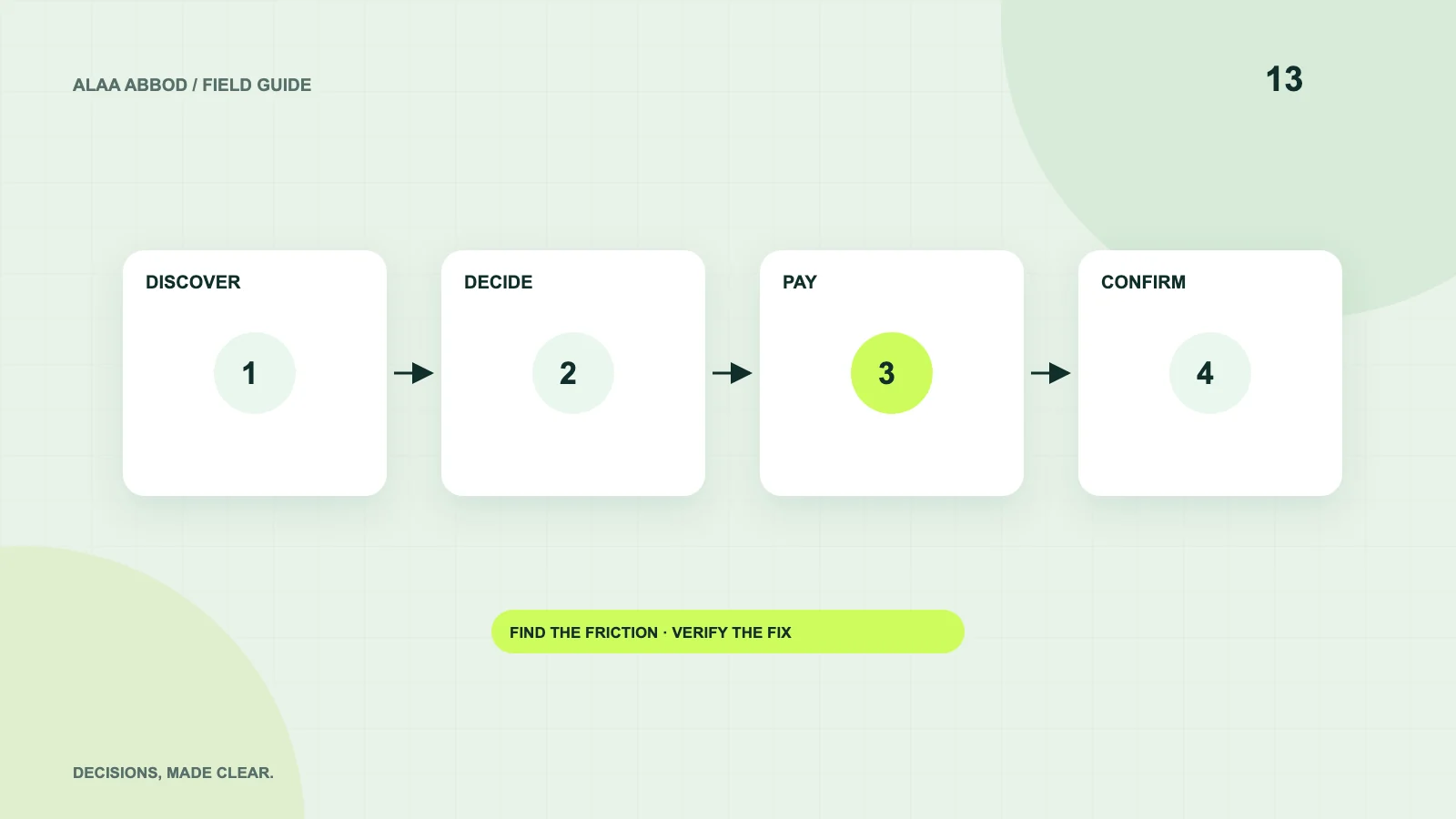
Map product view, add to cart, checkout start, payment attempt and confirmed paid order. Distinguish a browser button click from a server-confirmed commercial event. Define sessions or visitors consistently and account for consent-related measurement gaps.
Segment by acquisition source, device, product type and new versus returning customer only where the data is reliable. A campaign bringing a different audience can change the apparent conversion rate without changing the store. Keep a written event dictionary before comparing periods.
| Observed difficulty | Evidence to inspect | First intervention |
|---|---|---|
| Product view to cart | Questions about fit, variants or availability | Clarify product and variant information |
| Cart to checkout | Unexpected shipping or uncertain delivery | Explain total cost and delivery earlier |
| Checkout abandonment | Field errors, keyboard behavior, account friction | Simplify required steps and make recovery clear |
| Payment failure | Provider states and failed confirmation | Offer a safe retry and accurate order status |
| High returns | Expectation mismatch and product descriptions | Improve decision information before purchase |
Chapter 02 / 06
Product information is part of the interface
A buyer needs to know what is included, whether a variant fits, when it will arrive and what to do if it is unsuitable. Put that evidence near the decision, using plain descriptions and genuine images. Do not manufacture scarcity, customer counts or reviews.
For configurable products, explain unavailable combinations and preserve the chosen variant when the user navigates back. Translate specifications and units where needed; do not make the buyer reconstruct essential information from a generic manufacturer paragraph.
Chapter 03 / 06
Make costs and errors understandable
Unexpected delivery cost or an unclear return process can invalidate the buyer’s decision at checkout. Show relevant conditions before commitment. Keep payment errors actionable without exposing private provider details, and avoid creating a second order when someone retries.
On mobile, test keyboard types, autofill, focus placement and error summaries. Allow a correction without clearing the form. Accessibility work improves reliability for more users, but do not claim an unmeasured revenue increase simply because a control was fixed.
Chapter 04 / 06
Prioritize one credible hypothesis
Write a hypothesis with a cause, a change and a primary outcome. For example: customers cannot distinguish two sizes; add a measured size guide near variant selection; review valid orders for those products and size-related returns. That is more useful than a vague instruction to improve the checkout.
Choose evidence first: support questions, observed task failures, payment logs stripped of personal details and reproducible interaction defects. An urgent broken payment does not need an A/B test. A preference between two persuasive headlines usually needs a stronger experimental plan.
- Observe Locate a repeatable difficulty in a purchase task.
- Explain Write the proposed cause and competing explanations.
- Change Ship the smallest coherent correction.
- Review Compare the primary outcome and safety metrics.
Chapter 05 / 06
Treat experiments as estimates
Suppose an illustrative baseline has 1,000 eligible sessions and 20 orders: 2.0%. A later period has 1,000 sessions and 24 orders: 2.4%. The arithmetic is a 0.4 percentage-point difference and a 20% relative increase. It is not proof that a design change caused the difference.
Traffic mix, promotions, stock and chance can explain it. Plan sample size, allocation, duration and stopping rules before an experiment; use qualified statistical support where needed. For low volume, combine usability testing with operational evidence and avoid declaring winners from a handful of purchases.
| Measure | Baseline | Later period |
|---|---|---|
| Eligible sessions | 1,000 | 1,000 |
| Orders | 20 | 24 |
| Observed rate | 2.0% | 2.4% |
| Interpretation | Reference period | Difference needs causal evaluation |
Chapter 06 / 06
Judge business quality as well as purchases
A discount can raise order count while reducing contribution margin. A confusing product claim can raise purchases and returns together. Track valid paid orders, margin after relevant costs, cancellations, returns and support burden with explicit definitions.
Keep a dated change log and explain measurement limitations. Give the team one prioritized backlog rather than a collection of unrelated tricks. A useful optimization makes the buying decision clearer and the order more reliable; its business benefit must then be demonstrated.
For implementation: Explore the relevant service.