

Chapter 01 / 06
Prototype, MVP and production platform are different purchases
A clickable prototype can help test understanding without real accounts or persisted data. A concierge pilot can deliver the service manually while testing demand. A software MVP implements the key workflow with enough reliability for the intended users and data.
Describe the learning goal before writing features. A scheduling product might test whether a team repeatedly uses shared availability; it may not need calendar synchronization, billing and an analytics dashboard in the same first release. Exclude features explicitly, while retaining the safeguards required for the real workflow.
| Scenario | Assumed effort | Calculated development budget |
|---|---|---|
| Interactive prototype | 40–80 hours | €4,000–€8,000 |
| Focused web MVP | 200–400 hours | €20,000–€40,000 |
| MVP with integrations and payments | 400–700 hours | €40,000–€70,000 |
| Mobile MVP with backend | 500–900 hours | €50,000–€90,000 |
Chapter 02 / 06
Estimate one complete workflow
List the happy path and its important failures. For an authenticated task tool, include invitation, login, password recovery or chosen identity provider, task creation, ownership, permission boundaries and account support. An admin dashboard must have authorization, not merely a hidden URL.
Payments add failure states, webhook verification, duplicate-event handling, refunds and reconciliation. APIs add contracts, timeouts and dependency failures. These responsibilities explain why apparently simple screens can require substantial work. Decide which services to buy and which behavior truly belongs in your code.
Chapter 03 / 06
A worked allocation for a web MVP
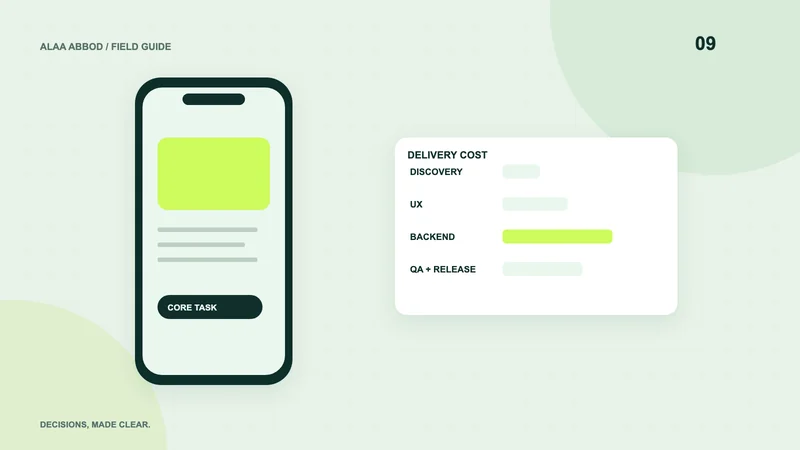
Assume 30 hours for discovery, 40 for interaction design, 80 for frontend, 100 for backend and integrations, 50 for QA and 20 for launch and documentation. The total is 320 hours, or €32,000 net at the assumed rate. This is an illustrative allocation, not a promised delivery price.
It excludes complex data migration, regulated workflows, extensive localization and third-party charges. Add a separate uncertainty allowance based on the unresolved risks, and agree how it can be used. A fixed contingency percentage without a risk discussion is less useful than a tested integration spike.
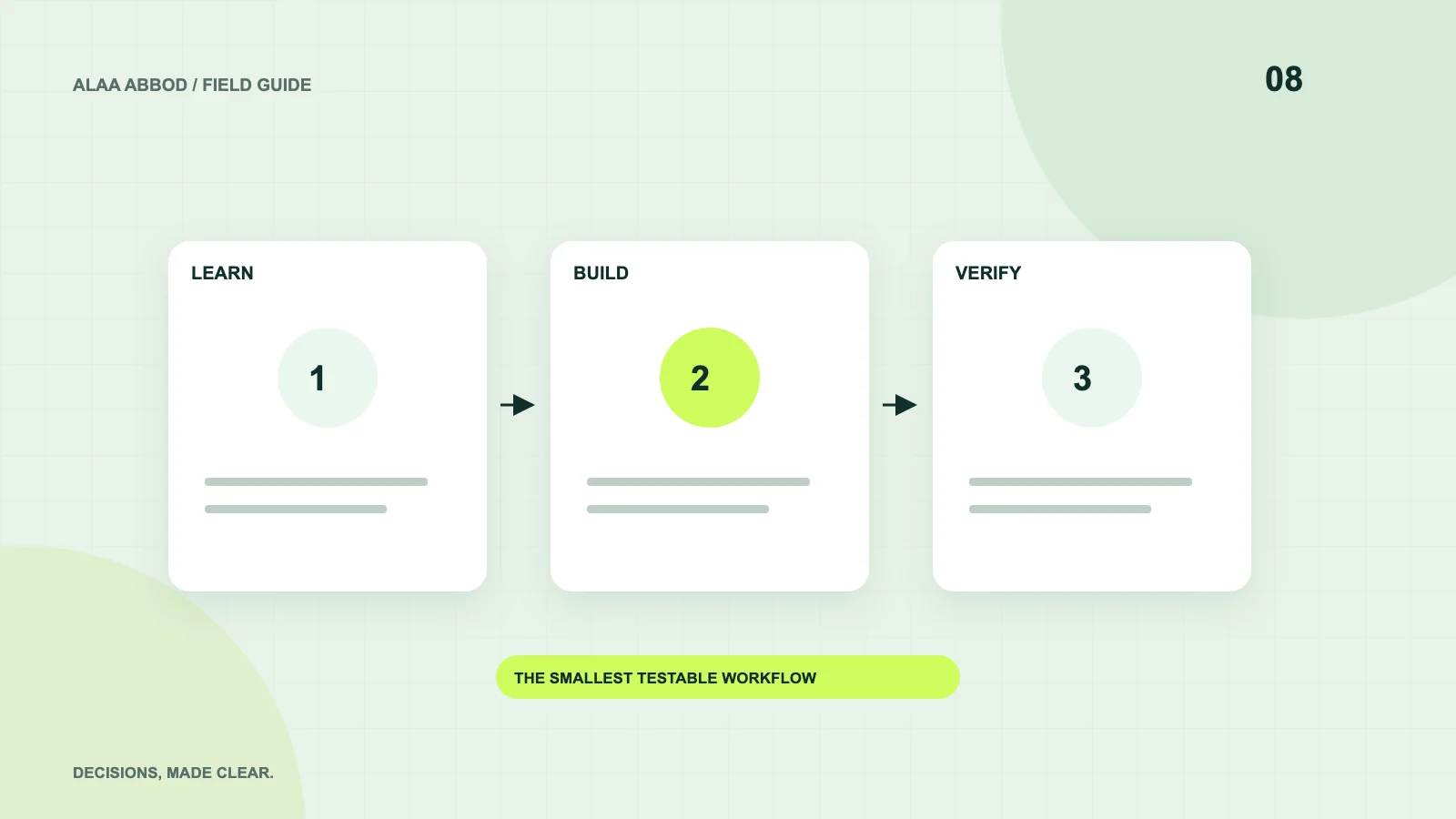
- Workflow Choose the task users must complete repeatedly.
- Risk Prototype the uncertain integration or permission model.
- Release Build and test the bounded usable product.
- Iteration Review actual behavior and decide the next investment.
Chapter 04 / 06
Choose web or mobile for the task
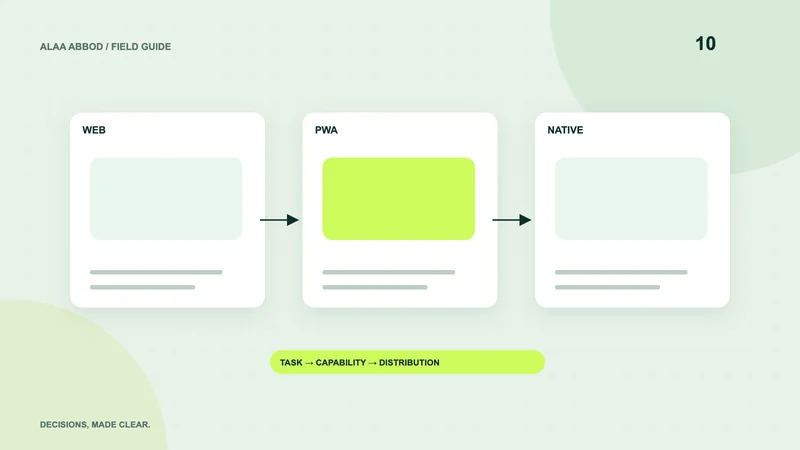
A web app is often easier to distribute and update when the workflow is link-based or used on a laptop. A native or cross-platform mobile app may be justified by repeated mobile use, device features or offline requirements. A PWA can add installation and some offline capabilities, with browser-dependent limits.
Do not choose a technology because it appears cheaper per screen. Account for platform-specific behavior, backend operations and the team’s ability to maintain it. Test the hardest required capability on the intended devices before committing.
Chapter 05 / 06
Launch includes the unglamorous work
Provide a deployment process, monitoring, backups with a restore test, error handling and a support route. Limit the data collected to what the service needs and define access and deletion responsibilities. Test authorization between users or organizations if the product is multi-tenant.
Prepare onboarding and a feedback process. A product cannot teach you much if its first users cannot reach the core task. Document credentials ownership, service charges and how another developer can continue.
Chapter 06 / 06
Pay for a learning cycle, not an endless first release
Choose the pilot audience and a measurable behavior: repeated task completion, a paid pilot or a demonstrated reduction in a specific manual step. Avoid assuming that registrations alone validate value. Record the question, observation period and decision rule.
Set aside capacity for fixes and one informed iteration after launch. When a request appears, ask whether it tests the chosen assumption or merely expands the product. An MVP succeeds when it enables the next business decision with evidence.
For implementation: Explore the relevant service.