

Chapter 01 / 07
Start with the business model
A specialist B2B service may need a small number of suitable conversations. A subscription product needs activation and retention. An ecommerce brand needs repeatable orders with viable contribution. A local service needs discoverability where it can actually deliver.
Write the customer, purchase frequency, decision cycle, geography, margin assumptions and proof required. Identify the next step that represents progress. A download can be useful research interest without being a qualified opportunity.
| Model | First channel hypothesis | Proof to watch |
|---|---|---|
| Specialist B2B service | Useful expertise plus targeted outreach or partnerships | Qualified conversations and pipeline fit |
| Searchable service need | Commercial SEO and a bounded Search test | Relevant visits and suitable inquiries |
| Visual consumer product | Demonstration-led creative and commerce pages | Valid orders, margin and returns |
| New software product | Direct discovery conversations and a focused content route | Activation and repeated use |
| Local service | Accurate local presence and service information | Inquiries within the served area |
Chapter 02 / 07
Build a destination that can do its job
Every channel needs somewhere credible to send interest: a service page, a product page, a demonstration or a clear consultation path. The destination must explain the offer, evidence, conditions and next step. Make contact and purchase work reliably on a phone.
Use a modest website with coherent pages rather than postponing the destination until every visual detail is perfect. Keep important content readable without unnecessary motion. A broken form can make an otherwise relevant campaign look ineffective.
Chapter 03 / 07
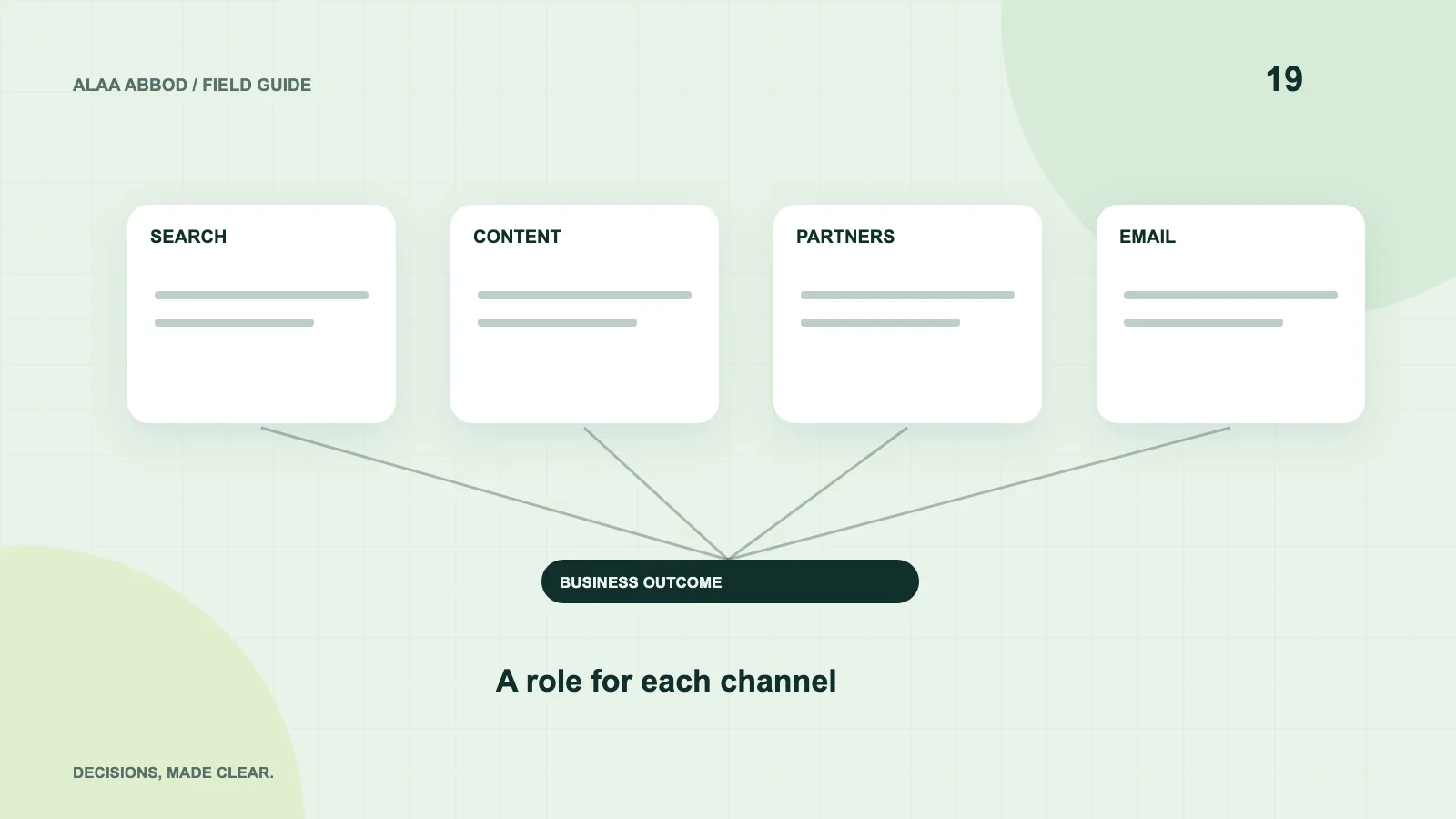
Assign a role to each channel
Search can capture articulated demand. Editorial content can answer decision questions over time. Social content can demonstrate a problem or maintain familiarity. Partnerships can introduce trust and access to a relevant audience. Email can support a permitted ongoing relationship.
These are operating hypotheses, not universal performance laws. A channel can serve several roles, but a startup should name its primary one. Reposting the same slogan everywhere creates activity without explaining how it helps the customer move forward.
- Discovery
- Help the right person recognize the problem.
- Evaluation
- Provide criteria, evidence and comparison.
- Action
- Make inquiry, purchase or trial understandable.
- Retention
- Support continued value and an appropriate relationship.
Chapter 04 / 07
Budget for production and follow-up
Advertising spend is only part of marketing cost. Include research, writing, creative, landing pages, measurement, response handling and content maintenance. A founder’s time is a real resource even when it is not invoiced.
Choose a cadence the team can maintain. One strong decision article connected to a service page can be more useful than daily posts with no purpose. A paid test needs someone to inspect relevance and respond to the opportunities it produces.
Chapter 05 / 07
Use one focused experiment
Write the hypothesis, audience, message, destination, primary outcome, budget limit and review date. For a B2B service, test whether a specific problem explanation leads to suitable conversations. For a shop, test whether a demonstration reaches buyers whose orders remain economically useful.
Do not change offer, audience and landing page simultaneously without a record. Otherwise you cannot explain which part helped. Keep other influences such as promotions and stock changes in the log. An inconclusive test is a reason to improve evidence, not to invent a success story.
- Hypothesis State audience, problem and expected action.
- Preparation Build evidence and a working destination.
- Execution Run within budget and capacity.
- Decision Continue, revise or stop using documented outcomes.
Chapter 06 / 07
Measure a ladder rather than a vanity total
Use reach or impressions to understand distribution, relevant visits to understand interest, qualified actions to understand progress and retained value to understand quality. Each needs a definition. Do not combine followers, downloads and purchases into one success count.
Document privacy-related coverage limits and ask prospects how they found the business when appropriate. Attribution systems can disagree. Review channel contribution with business evidence instead of treating one platform’s credited conversions as the complete customer journey.
Chapter 07 / 07
Expand when a role is missing
If qualified interest exists but inquiries fail, improve the destination and follow-up. If the destination works but few suitable people arrive, test acquisition. If orders arrive but customers do not return, investigate product value and retention before buying more reach.
Add a second channel when it fills a specific gap and the team can operate it. Keep account access, content assets and decision records in business-owned systems. A sustainable marketing setup connects a useful offer to the right people and learns without exceeding the company’s capacity.
For implementation: Explore the relevant service.