


Chapter 01 / 07
Demand capture and discovery are different jobs
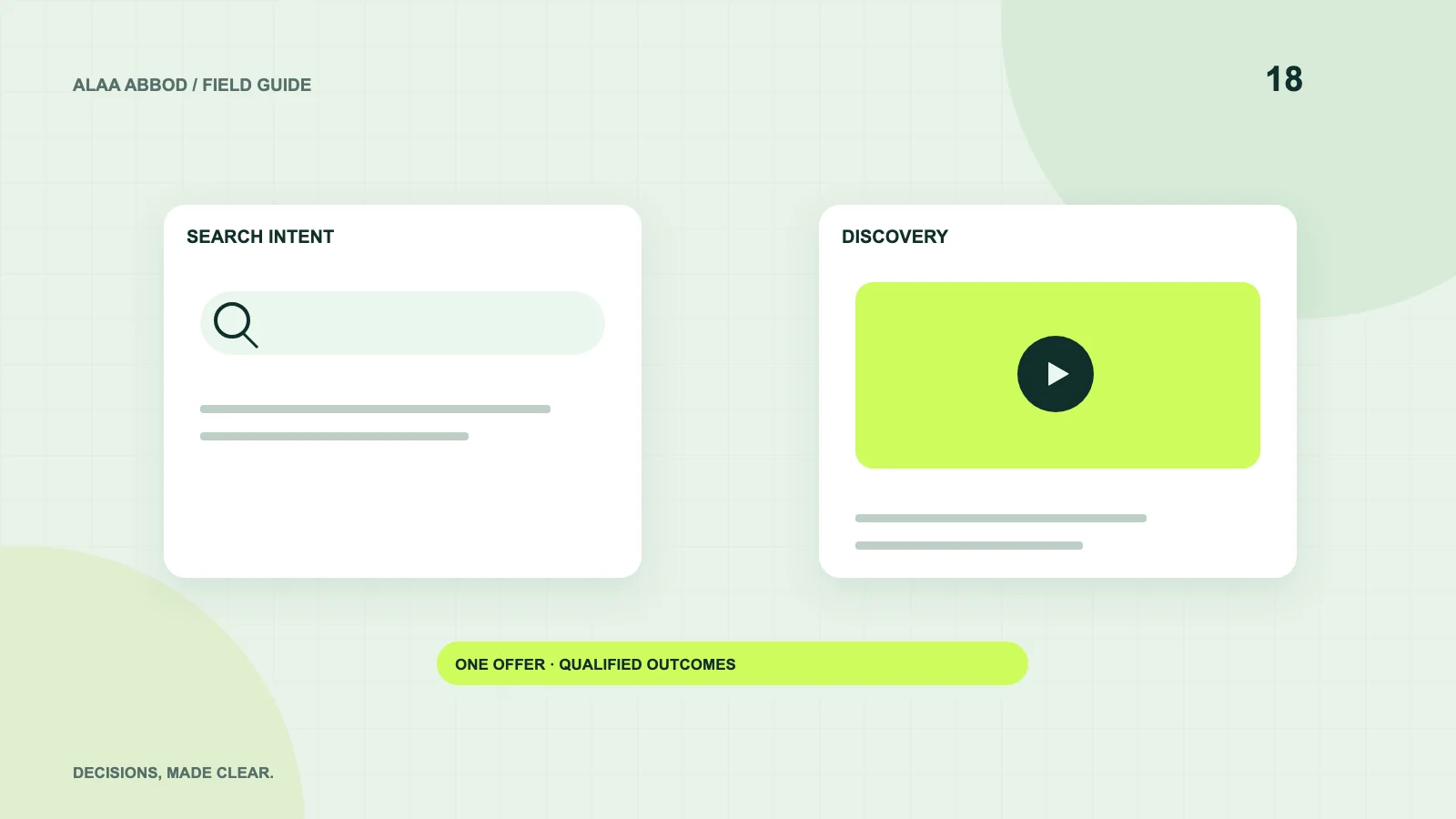
A person searching for a website provider has expressed intent, though the exact query may still be informational or unsuitable. A person encountering a product demonstration in a feed may not have planned to buy, but the creative can make a problem recognizable.
This distinction is a planning model, not a claim that Google only captures demand or Meta only creates it. Google offers more than Search, and Meta can reach people who already know the business. Specify the actual placement, objective and audience when comparing.
| Context | Google Search hypothesis | Meta hypothesis |
|---|---|---|
| Clear provider search | Capture explicit commercial queries | Introduce the offer or reinforce familiarity |
| Visually demonstrable product | Target relevant product queries | Demonstrate the benefit with useful creative |
| New product category | Search demand may need education | Test problem recognition and explanation |
| B2B service | Match specific problems and qualify inquiries | Test relevant stories; validate lead quality |
| Repeat purchase | Capture repeat or product queries | Evaluate lawful customer or remarketing audiences |
Chapter 02 / 07
Match the landing page to the promise
A search ad about a scoped service should reach a page explaining that service, not a generic homepage. A demonstration ad should continue the demonstration and answer price, suitability and delivery questions. Keep the first action aligned with the audience’s readiness.
For lead generation, ask only the information needed to evaluate fit. Explain the next step and response expectations you can actually meet. For ecommerce, show the product, variant, total-cost context and availability. An ad cannot repair an unclear buying proposition.
Chapter 03 / 07
B2B needs a lead-quality definition
A low form-submission cost can hide inquiries outside your market, budget or service scope. Define a qualified lead using the business’s actual criteria. Record relevant outcomes from sales follow-up without collecting unnecessary personal data.
Longer buying cycles can make immediate purchase metrics unsuitable. Use an intermediate action only when it reliably indicates progress, such as a meaningful consultation request. Review what happened after the click rather than optimizing solely for the easiest conversion event.
Chapter 04 / 07
Ecommerce needs contribution economics
Suppose an invented example has 100 orders from 2,000 EUR in ad spend: the acquisition cost is 20 EUR per order. If contribution before ads is 15 EUR per order, that first purchase does not cover acquisition. Revenue alone would conceal the problem.
Use your own costs, returns, tax treatment and repeat-purchase evidence. Do not justify a loss with an imagined lifetime value. Include creative production and operating work when evaluating the complete channel investment.
| Item | Assumed value |
|---|---|
| Ad spend | 2,000 EUR |
| Attributed orders | 100 |
| Spend per order | 20 EUR |
| Contribution before ads | 15 EUR per order |
| First-order gap | 5 EUR per order before other acquisition costs |
Chapter 05 / 07
Remarketing is a privacy and relevance decision
Reaching a previous visitor or customer can be useful when the message fits their stage. It also requires a valid data-processing and tracking setup for the relevant jurisdiction. Do not send form contents, sensitive information or unnecessary identifiers to ad platforms.
Assess the actual tags, consent choices and audience rules before launch. A server-side integration does not remove privacy duties. If lawful measurement coverage is limited, document the limitation rather than pretending reported attribution is complete.
Chapter 06 / 07
Design a test you can interpret
Choose one offer, market, primary outcome and bounded budget. Give creative and landing-page work an owner. For Search, review actual query relevance where reporting allows it. For Meta, review whether creative attracts the intended buyer, not merely interaction.
Do not split a small budget across too many objectives and audiences. Decide review dates and stopping conditions in advance. Check broken tracking or form delivery before declaring a channel unsuccessful, and separate campaign failure from an offer that nobody wants.
- Offer One audience and a clear proposition.
- Journey A relevant page and reliable next action.
- Outcome Qualified lead or economically useful order.
- Review Budget limit, evidence and decision date.
Chapter 07 / 07
Choose the next constraint, not a permanent winner
If relevant search demand exists, Search may be a sensible first test. If the benefit needs demonstration, Meta may be a useful discovery test. If neither generates a clear signal, investigate the offer, audience and journey before adding more channels.
The eventual mix can include both. Keep business-owned accounts, documented measurement and reusable creative. A startup needs a learning system it can afford, not an ideological commitment to one advertising platform.
For implementation: Explore the relevant service.