


Chapter 01 / 08
Start with the buyer’s decision
List the problem, buyer, alternatives, budget constraints and proof the customer needs. Separate searches for a definition from searches for a provider. A founder comparing implementation prices needs scope and trade-offs; a buyer choosing a service needs evidence of fit and a clear next step.
Read search results to understand intent, not to copy competitors’ headings. Interview sales or support where available. Build a page map around distinct decisions. Avoid separate pages for near-identical keyword variants if the answer and offer are the same.
| Decision | Useful page | Evidence needed |
|---|---|---|
| What is this? | A concise explanation | Definition, boundaries and examples |
| What does it cost? | A scope and budget guide | Assumptions, exclusions and cost drivers |
| Which approach fits? | A comparison | Decision criteria and limitations |
| Who can deliver it? | A service page | Relevant capability, process and contact |
| Will it work for us? | A practical implementation guide | Concrete checks and honest constraints |
Chapter 02 / 08
Establish a technical foundation
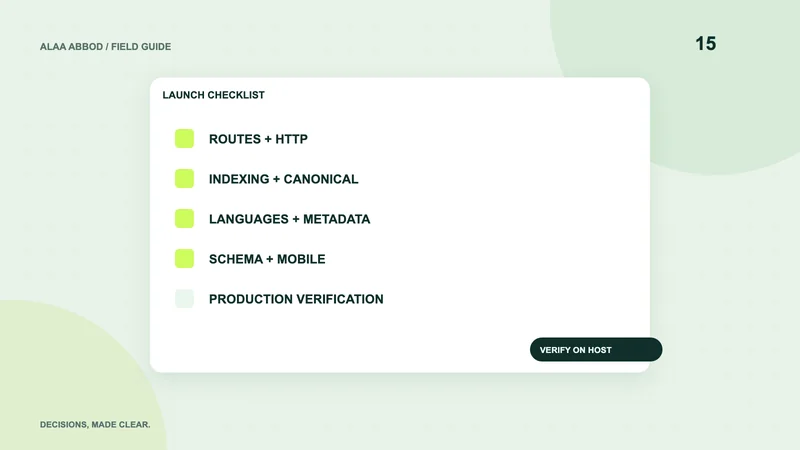
Important pages should return a successful HTTP response, render meaningful content and link from the site. Check accidental noindex directives, blocked resources, incorrect canonicals, redirects and sitemap URLs. A sitemap helps discovery; it does not guarantee indexing.
Review phone performance and accessibility with real page types. Do not spend the entire budget chasing a perfect laboratory score while the offer remains unclear. Resolve defects that block discovery or use, then record remaining improvements according to impact.
Chapter 03 / 08
Make commercial pages specific
A service page should answer who the work is for, what outcome is in scope, what inputs the client must provide and how the project proceeds. Explain exclusions and the next step. Real evidence can include a documented implementation method, a transparent demonstration or an accurately described project.
Do not invent customer logos, testimonials or regional offices. If you serve German customers remotely, say so. A location page needs genuine local relevance; replacing the city name across identical pages creates little value for customers.
Chapter 04 / 08
Build a small, connected content library
Choose articles that remove a real buying obstacle: costs, platform comparisons, relaunch decisions, implementation risk and language support. Give each one an answer, criteria and a practical next action. Link it to the relevant service and to supporting technical evidence.
The strongest material is information your business can explain precisely. This site’s RTL, typography and animation measurements help support multilingual implementation advice. Preserve their original context and dates rather than presenting every historical measurement as today’s benchmark.
Chapter 05 / 08
Localize language and market separately
German content should reflect German buyer vocabulary and the actual offer. English can serve international teams in Germany, while Arabic may serve a different audience or the same business in another preferred language. Language alone does not define a country.
Use separate URLs and reciprocal hreflang links for genuinely equivalent versions. Keep a canonical for each language page. Adapt examples, terms and service availability; do not force an automatic location or language redirect that prevents a visitor from choosing another version.
Chapter 06 / 08
Build authority through verifiable information
Name the author, explain relevant expertise and identify primary references. Keep business details consistent across the site and legitimate external profiles. Earn attention with useful research, participation and partnerships rather than buying a package of unexplained links.
A professional certificate can be stated accurately; it does not imply endorsement or a search ranking advantage. Original information is valuable when its method and limits are visible. A small measured explanation can be more useful than a long generic guide.
Chapter 07 / 08
Measure a commercial path
Connect search impressions and clicks to the landing pages involved, then evaluate qualified inquiries, purchases or other agreed outcomes. Document consent-related gaps and avoid treating every form submission as a qualified lead. A reduction in low-quality submissions may be a business improvement even if raw counts fall.
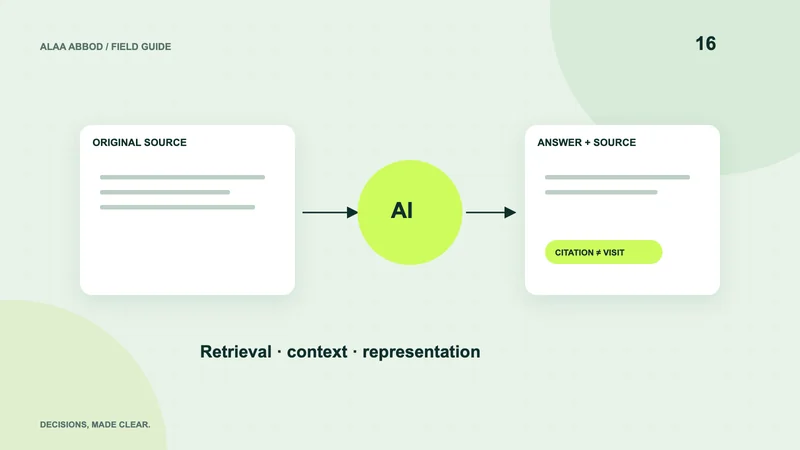
For AI visibility, examine available platform reporting separately from conventional traffic. An AI citation is not automatically a website visit or a sale. Use a small repeatable observation set to explore differences, and do not claim universal share of AI answers from a handful of prompts.
- Discovery
- Are important pages crawled and eligible for indexing?
- Visibility
- Which relevant queries or report dimensions show the pages?
- Visit quality
- Do visitors engage with the right commercial information?
- Business result
- Are inquiries qualified or orders economically useful?
Chapter 08 / 08
A realistic first ninety days
In the first phase, fix discovery, clarify the main offer and establish measurement definitions. Next, publish a few substantial decision articles and improve internal links. Then review which pages attract the right audience, what questions remain unanswered and where inquiry quality fails.
This is a planning sequence, not a promise of rankings within ninety days. Budget depends on competition, existing authority, implementation quality and the offer. Avoid buying hundreds of generated pages, packages promising fixed search positions or speculative AI markup while the basics are unfinished.
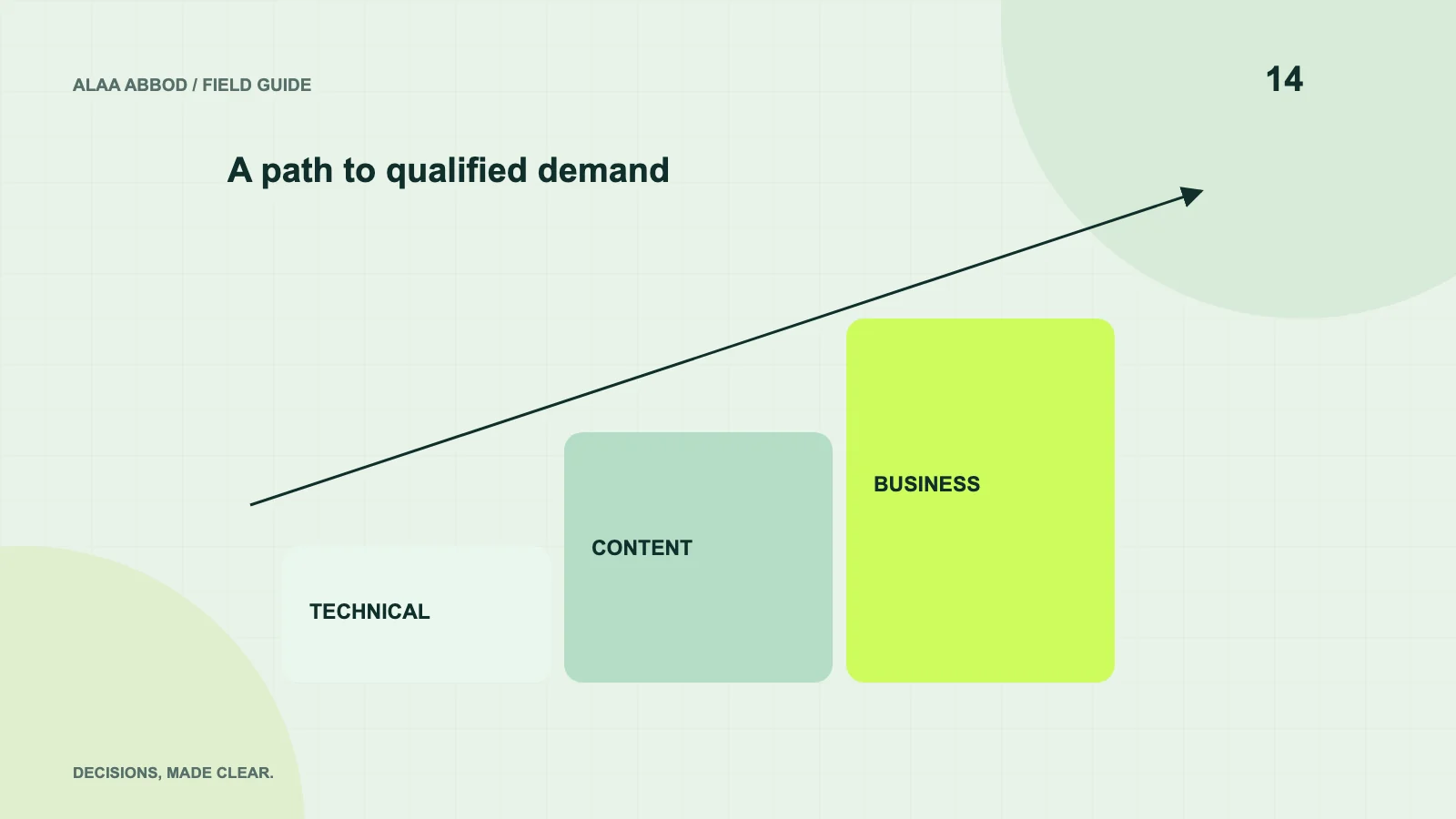
- Foundation Technical discovery and one clear commercial route.
- Evidence Useful comparisons, scope guides and relevant expertise.
- Connection Language-aware internal links and service destinations.
- Learning Review qualified outcomes and choose the next constraint.
For implementation: Explore the relevant service.