

Chapter 01 / 08
Audit what the business says about itself
Collect the company name, domain, service scope, markets, contact details and author identity from the homepage, services, articles and genuine external profiles. Look for conflicting descriptions. An old phone number or a vague service boundary creates ambiguity for customers before any AI system becomes involved.
Write one concise factual description and adapt it to the context of each page. Avoid copying identical sales paragraphs everywhere. A service page can explain delivery; an author page can explain expertise; a legal page should supply accurate required business information.
| Fact | Where to check | Useful correction |
|---|---|---|
| Name and domain | Header, footer, metadata and profiles | Use a consistent real identity |
| Offer | Services and related articles | State actual scope and exclusions |
| Markets and languages | Localized pages | Describe availability accurately |
| Contact | Visible links and schema | Remove outdated numbers and destinations |
| Author | Bylines and professional details | Attribute expertise without invented endorsements |
Chapter 02 / 08
Verify access through the complete stack
Check status codes, robots directives, rendered text, canonicals and internal links. Then examine hosting and security rules. A public HTML page should remain available to legitimate retrieval while private endpoints and rate-limited forms remain protected. Do not disable security across the site just to chase crawler access.
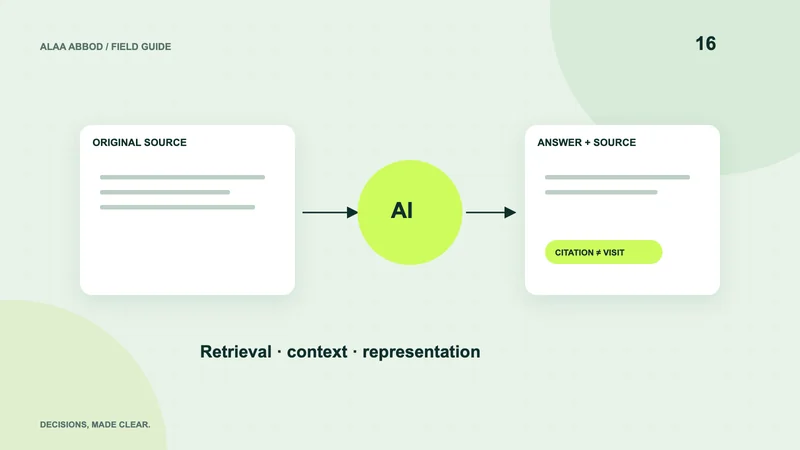
Use official crawler documentation and verify identity where security rules depend on it. OpenAI’s search and training crawlers serve different purposes. Decide access deliberately; do not assume blocking training also blocks search, or allowing a crawler produces a citation.
Chapter 03 / 08
Choose one commercial question worth answering
A startup website should answer questions such as implementation cost, platform fit, language support or release risk with enough detail to help a decision. Build a brief containing the intended reader, the decision, available evidence and a next step.
Use a transparent calculation, comparison or worked scenario. Label assumptions, exclusions and uncertainty. Do not disguise an invented example as a client success story. A page about cost gains credibility by explaining why scope changes rather than asserting one attractive price.
Chapter 04 / 08
Turn expertise into inspectable information
Technical expertise becomes useful when the reader can inspect a method or reproduce a check. On this site, original RTL and typography articles explain actual implementation issues. A commercial multilingual guide can connect to them while keeping historical measurements in their original context.
Attribute the article to Alaa Abbod, identify relevant skills and cite external technical facts near the reference section. The Google AI Essentials certificate can be stated as a professional qualification; it does not make the website an officially endorsed Google provider.
Chapter 05 / 08
Make the page structure serve the reader
Use a direct answer followed by a coherent explanation. Keep headings descriptive, provide tables for genuine comparisons and link the related service. Make definitions precise enough that a reader can distinguish SEO, AI citation and referral traffic.
Ensure the important information exists as text rather than only inside an illustration. Use appropriate image descriptions and readable mobile tables. Structured data should identify what is visibly present. Avoid adding unsupported properties in the hope of instructing an answer engine.
Chapter 06 / 08
Build external consistency without fabricated signals
Check legitimate business and professional profiles that you control. Correct outdated descriptions and links. Participate where you have useful information, and make any partnership or project claims verifiable. Do not manufacture forum recommendations or customer testimonials.
External coverage can introduce new audiences, but buying an unexplained mention package is not evidence of expertise. Keep a record of genuine references and their context. Measure the inquiries they bring rather than treating every domain mention as an authority score.
Chapter 07 / 08
Separate report observations from business attribution
Use the current generative-AI view in Google Search Console and available Bing AI Performance views as platform-specific evidence. Keep their reporting units separate. Then inspect real referral sessions and qualified outcomes using your consent-aware measurement setup.
For ChatGPT or Gemini observations without an equivalent owner report, document a limited question sample. Record the exact product, language, date, question, cited page and accuracy. Do not extrapolate an overall share from that sample, and do not describe missing referrers as proof that no AI influence occurred.
| Field | Example value, solely for planning |
|---|---|
| Question | Which approach suits a multilingual service website? |
| Product and mode | Record the actual application and search state |
| Language and region | Record the tested locale and context |
| Result | Mention, citation, incorrect claim or no relevant source |
| Source URL | Exact referenced page, if present |
| Business evidence | Separately recorded visit or qualified inquiry |
Chapter 08 / 08
Maintain facts and test improvements
Assign each important fact an owner and review trigger: new platform terms, changed service availability, outdated contact details or a technical claim affected by implementation changes. Update a page’s modified date only when the content meaningfully changes.
Prioritize corrections that make the page more useful even if an AI platform never cites it. Keep before-and-after evidence, acknowledge other causes of visibility changes and retain a manageable editorial scope. A robust visibility program is also a better information system for customers.
- Baseline Audit facts, access and one question set.
- Improve Revise one important page with evidence.
- Verify Test languages, links and mobile reading.
- Review Compare observations and qualified outcomes.
For implementation: Explore the relevant service.