

Chapter 01 / 08
Define the outcome before the acronym
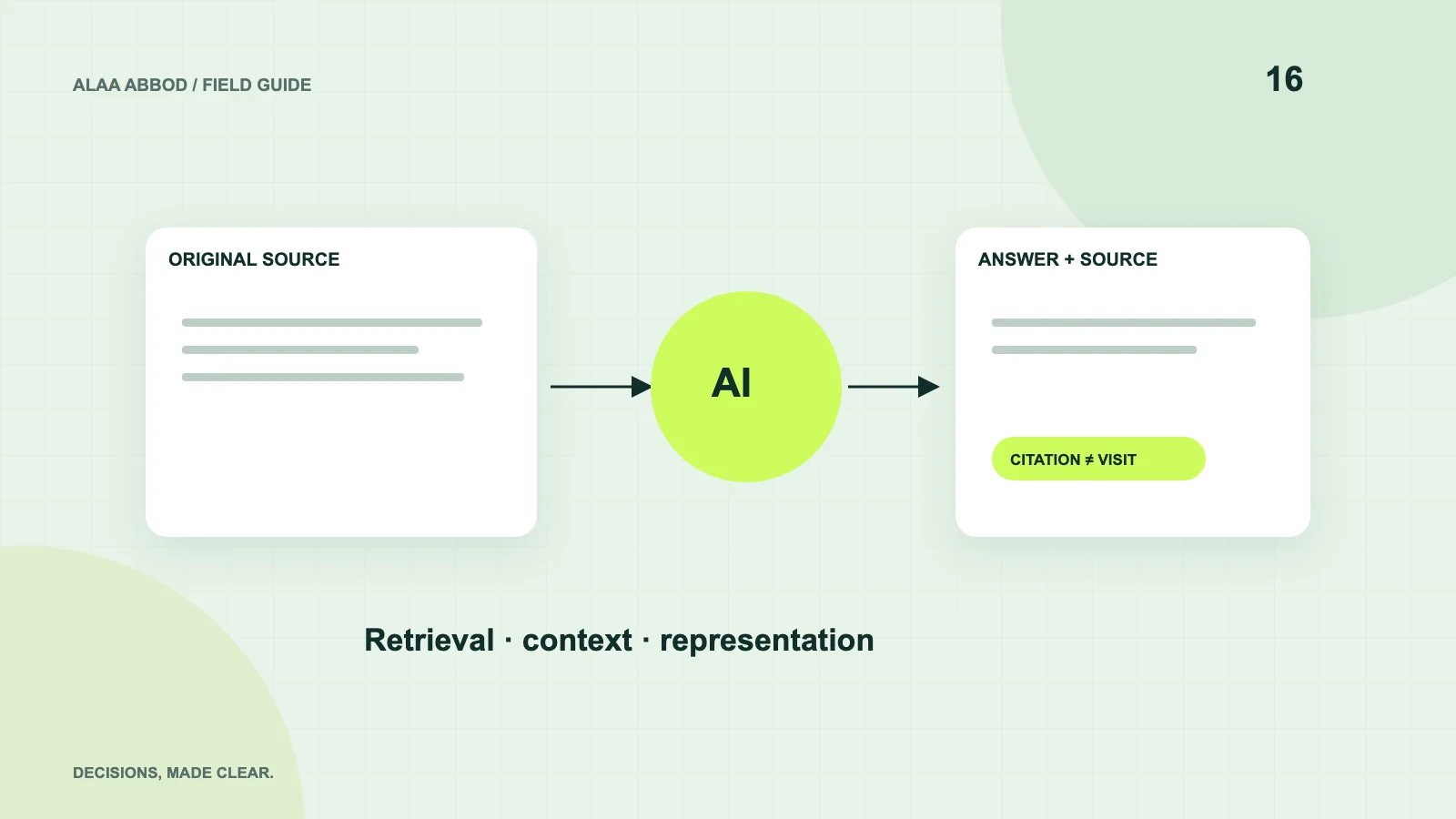
A company may want a correct description, a cited explanation, a product included in a comparison or a qualified visit. These are different outcomes. An answer can mention a brand without linking it; it can link a source without producing a click; it can also misrepresent the offer.
Choose the business question first. For a service provider, accurate scope and a useful next step may matter more than being mentioned in a broad definition. For a retailer, current product facts and availability are more actionable than a general claim of AI visibility.
| Signal | What it shows | What it does not prove |
|---|---|---|
| Mention | The name appears in one answer | A source link or qualified demand |
| Citation | A page is referenced | A visit, endorsement or sale |
| Referral | A user arrives from a source | That every relevant answer included the business |
| Qualified inquiry | A suitable prospect makes contact | That AI was the only influence |
| Model training | A system may use data for training | Live search inclusion or citation |
Chapter 02 / 08
SEO and GEO share a foundation
Useful public pages need to be accessible, coherent and connected. A detailed explanation with named authorship and visible references gives a human and a retrieval system more to understand than an unsupported slogan. Ordinary technical SEO remains part of that foundation.
GEO adds questions about representation in answers: what information is selected, whether it stays accurate and what a source citation means. Do not replace service pages with fragments written solely to be quoted. A page should remain a complete useful answer for the person who reads it.
Chapter 03 / 08
Distinguish the actual products
ChatGPT search, the Gemini application, Google Search AI Overviews and AI Mode, and Bing or Microsoft Copilot are different experiences. They can have different retrieval paths, controls and reporting. A behavior observed in one does not establish a rule for all.
When discussing Google Search, use Search documentation; do not treat a Gemini chat observation as a Search ranking test. When discussing ChatGPT, name whether search was used. Keep region, language, date and account context in any observation log.
Chapter 04 / 08
Crawler controls are purpose-specific
OpenAI documents OAI-SearchBot separately from GPTBot. Allowing search access and permitting training use are distinct choices. For Google Search AI experiences, evaluate Googlebot and documented preview controls rather than assuming a setting for other Google systems governs Search.
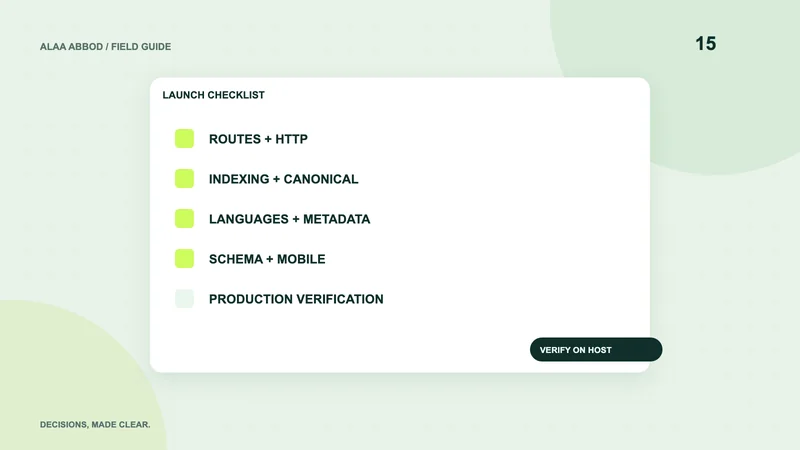
Crawler access can enable retrieval; it cannot guarantee selection. Test whether the public page can be fetched through the hosting and security layers. A robots rule is ineffective as an availability check if a firewall blocks the request first, and user-agent text alone is not reliable authentication.
Chapter 05 / 08
Present information with accountable context
Answer the main question clearly, then show the reasoning, examples and limitations. Use tables for comparisons and definitions for ambiguous terms. Link claims to primary sources and label a calculation as an assumption rather than a market fact.
Keep the author and business entity consistent. Original measurements should include what was measured and when. Reusable evidence matters more than repeatedly writing that the company is an expert. Accurate structured data can describe the visible page; Google states that no special AI schema is required.
Chapter 06 / 08
Use the reporting available in 2026
Google announced dedicated generative-AI performance reports in Search Console on 3 June 2026; its update says worldwide rollout was completed by 31 August. The announced view includes impressions and page, country, device and date dimensions. Read it as visibility reporting rather than a complete attribution model.
Bing’s AI Performance reporting covers citations in supported Microsoft experiences. Its June update added contextual reporting, including intents, topics, citation share and comparisons. These reports have different definitions and should not be merged into one supposed ranking.
- Platform
- Name the exact product and available report.
- Unit
- Record whether the metric is an impression, citation, visit or inquiry.
- Scope
- Record language, region, dates and report coverage.
- Interpretation
- State the decision the signal supports and its limits.
Chapter 07 / 08
Treat manual prompts as a research sample
Write a modest set of questions based on actual customer decisions. Repeat them with the same documented settings and record the answer, cited URL, accuracy and date. A different wording can retrieve different evidence. Save enough context to explain a change rather than chasing a single screenshot.
This is an exploratory sample, not a universal visibility percentage. Do not automate queries in ways that violate platform terms, and do not confuse generated praise with independent customer evidence. Use the findings to locate missing or unclear information on the site.
Chapter 08 / 08
Invest in useful evidence, not a secret recipe
Improve the pages customers need, maintain correct facts and make the business easy to identify. Publish original analysis only where you can explain the method. Correct outdated offers and inconsistent descriptions across legitimate profiles.
Be skeptical of promises of certain citations, invented AI scores or packages of fabricated external mentions. A sensible GEO project delivers understandable content, verified technical access and a documented learning process. It cannot sell control over another platform’s answers.
- Audit Inspect public access and factual consistency.
- Clarify Improve one important decision page.
- Connect Link supporting evidence and service details.
- Review Compare documented observations and business outcomes.
For implementation: Explore the relevant service.