


Chapter 01 / 05
Ten signs—and the evidence to collect
Use the signs below as investigation prompts, not an automatic justification to rebuild. A broken form is urgent, but it may need an endpoint fix rather than a new CMS. A structural mismatch between the website and the business may require a broader relaunch.
Collect a few concrete examples for each relevant sign: an abandoned task, an editor blocked by the CMS, a missing market page or an integration failure. Prioritize by the effect on customers and operations, not by how embarrassing the homepage feels internally.
- 1. The offer changed
- Visitors still see services or positioning the business no longer sells.
- 2. Mobile tasks fail
- Enquiry, purchase or navigation cannot be completed on small screens.
- 3. Content cannot be maintained
- Editors need developer intervention for ordinary updates.
- 4. Qualified traffic does not progress
- Use research to separate offer problems from interface friction.
- 5. Important pages are unreachable
- Navigation, indexing or permissions hide useful content.
- 6. Performance blocks the task
- Heavy assets, unstable layout or slow interactions interrupt buying.
- 7. Security ownership is unclear
- Updates, access and incident handling have no responsible owner.
- 8. Accessibility barriers persist
- Keyboard, contrast or errors prevent real users completing tasks.
- 9. New markets cannot fit
- The architecture cannot support localized pages and right-to-left reading.
- 10. Integrations are brittle
- Manual workarounds or silent failures undermine the intended process.
Chapter 02 / 05
Choose repair, refresh or rebuild
A repair fixes a bounded failure, such as a broken payment callback or an inaccessible form. A refresh adjusts presentation and selected content while preserving a useful structure. A rebuild changes content models, platform or core journeys because the current system cannot support them reliably.
These are different budgets and risks. Ask the delivery team to explain the smallest change that addresses the evidence. Replacing a functioning platform can introduce migration cost without solving the commercial problem.
| Finding | Likely starting point | Proof of completion |
|---|---|---|
| Form loses messages | Focused repair | Accepted request reaches the inbox |
| Offer is unclear | Content and visual refresh | Target customer understands the offer |
| Editors cannot publish | Workflow or CMS redesign | Editor completes a normal update |
| Architecture blocks expansion | Structured relaunch | New market flow works end to end |
Chapter 03 / 05
Keep what already works
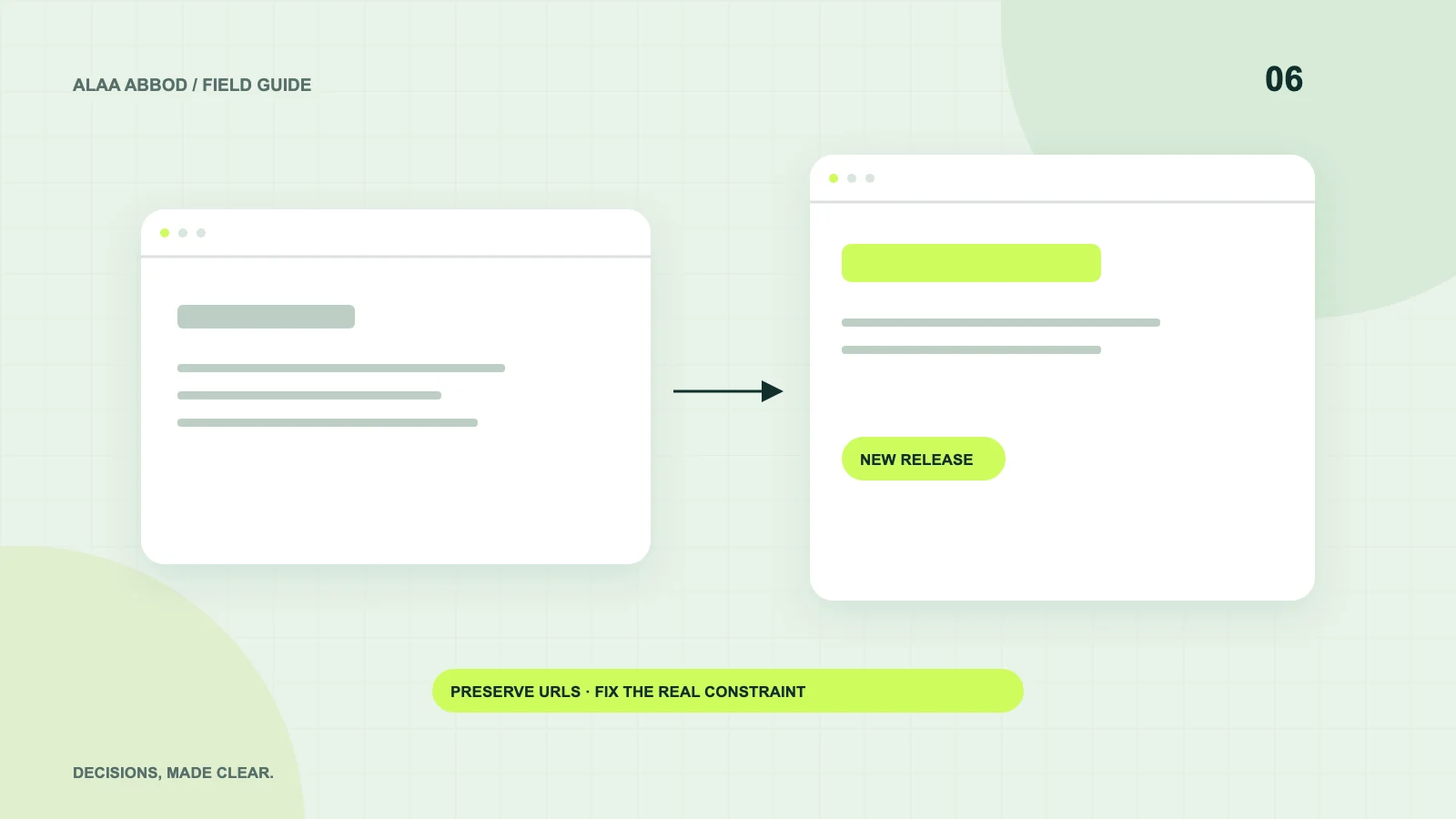
Inventory existing URLs, titles, content, downloads and inbound links before changing the structure. Keep stable article and service URLs when the subject remains the same. If a URL must change, map it to the closest genuine replacement with a permanent redirect; do not send every retired page to the homepage.
Preserve original publication dates and meaningful research. A new template does not make old measurements new. Add an update date when substance changes, and explain the version a historical finding applies to.
Chapter 04 / 05
Make launch a controlled migration
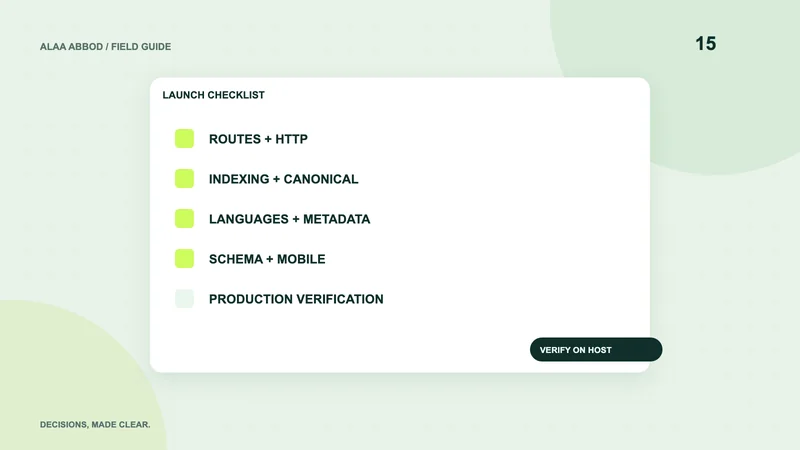
Build a route map and test the new site against it. Verify contact and purchase flows, language switching, images, metadata and redirects. Keep staging inaccessible to indexing and make sure that restriction does not remain on production.
Back up files and databases where present, rehearse the deployment and define rollback conditions. Give one person responsibility for the actual upload and live verification. A successful local build says nothing about missing server configuration after deployment.
- Baseline Record routes, valuable content and working conversions.
- Rehearse Run the migration and critical flows in a controlled environment.
- Release Verify real response codes and delivery after uploading.
- Review Monitor errors, search coverage and qualified outcomes.
Chapter 05 / 05
Judge the relaunch against its reason
If the problem was slow publishing, measure whether editors can now complete the task. If the problem was lost enquiries, prove delivery and monitor response quality. If the problem was international expansion, test equivalent-page switching and local content with actual readers.
Avoid declaring victory because the site looks newer. Keep a change record and compare comparable periods with attention to campaign and seasonal changes. A relaunch earns its cost when the identified constraint is removed.
For implementation: Explore the relevant service.