


Chapter 01 / 05
Match the team to the problem
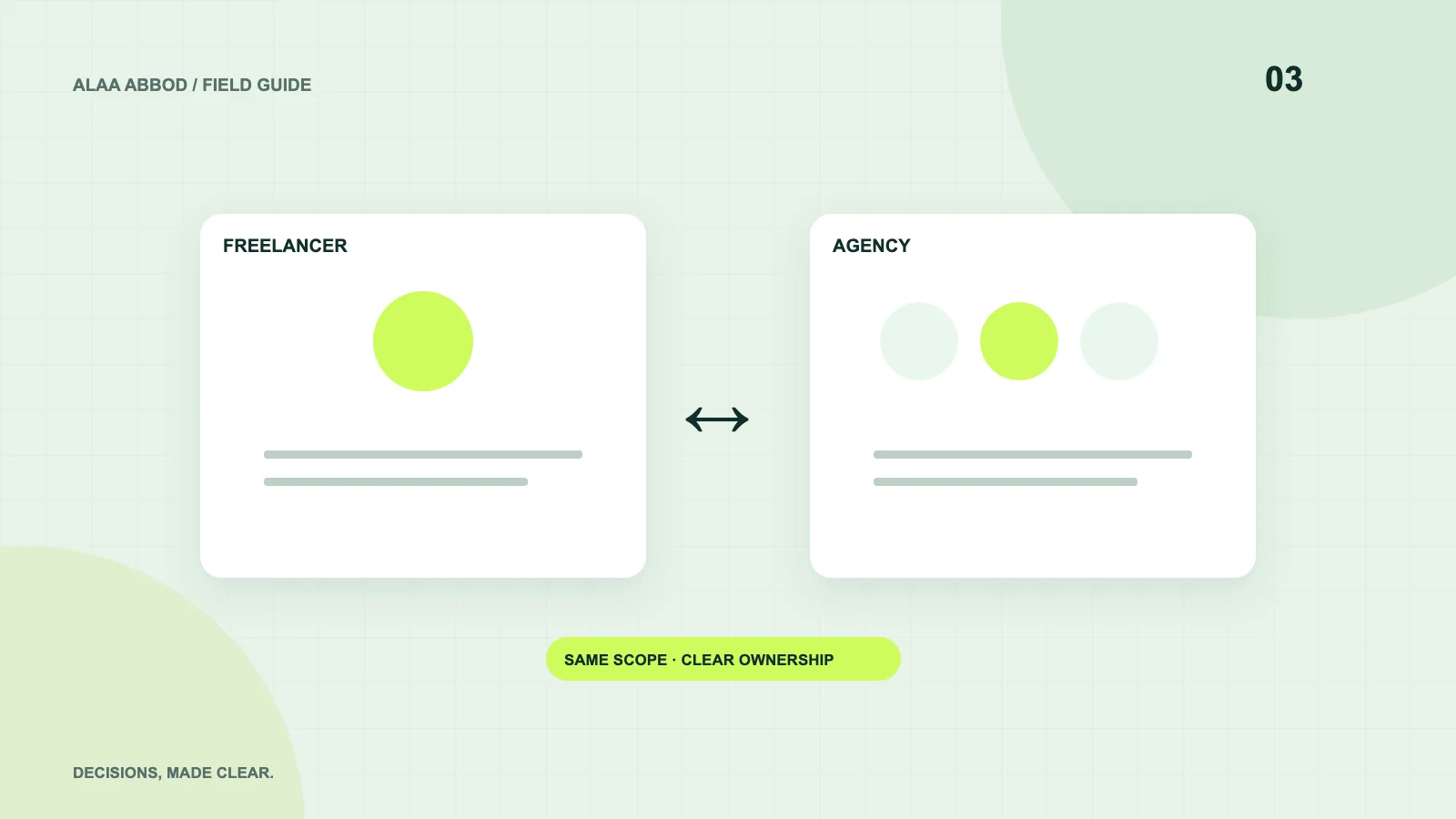
A small website needing coherent design and implementation may benefit from one practitioner owning both. A regulated product, complex migration or store with multiple operational systems may need specialists in content, integration, accessibility, security and testing. A freelancer can collaborate with specialists, and an agency can still assign one junior developer.
Write the actual roles needed before deciding the supplier type. Identify who answers questions, who can approve a change and who takes responsibility when design, code and content disagree. The weakest arrangement is a large handover chain with nobody accountable for the complete buyer journey.
| Question | Freelancer | Agency |
|---|---|---|
| Communication | Often direct access to the maker | May involve account and project management |
| Parallel capacity | Usually limited or via partners | Potentially multiple specialists |
| Continuity | Needs a documented backup arrangement | Depends on staffing and retention |
| Consistency | One person can connect design and build | Requires shared standards across roles |
| Cost | Less organizational overhead is possible | Management and cover may be included |
Chapter 02 / 05
A portfolio is evidence only when you can interrogate it
Open the examples on a phone. Try the navigation, form and keyboard flow. Ask which parts the proposed person created, which constraints the project had and whether the displayed work was a paid commission or a concept. A polished screenshot tells you little about loading, editing or error handling.
For a multilingual build, request a real right-to-left example. For a store, ask about stock conflicts, payment failures and refunds rather than only the homepage. For an app, ask who maintains it after an operating-system update.
Chapter 03 / 05
Compare the same scope
Give each supplier the same brief with objectives, page types, languages, content readiness and integrations. Ask for assumptions and exclusions. A low total excluding text entry, migration and launch QA is not directly comparable with a total that includes them.
Evaluate milestone payments against tangible deliverables. Define review rounds, the change process and acceptance conditions. Keep the domain and critical accounts under your organization’s control, and obtain the source and design files needed to continue with another provider.
- Brief Describe the actual problem and decision deadline.
- Review Discuss two relevant working examples with their maker.
- Trial scope Use a paid discovery or bounded first milestone before a large commitment.
Chapter 04 / 05
Continuity belongs in the contract
Ask how absence, illness or staff changes are handled. A freelancer’s documented system and emergency contact can be more useful than an agency’s vague support promise. Conversely, a committed service desk and cover arrangement can justify additional overhead when downtime has a high business cost.
Agree response windows separately from resolution promises. Distinguish a defect covered by warranty from new scope and ongoing maintenance. The agreement should explain backups, updates and the route for urgent incidents.
Chapter 05 / 05
Choose with a weighted decision
Rank the factors that actually matter: coherent design, technical depth, multilingual delivery, editor training, speed of decision and operational cover. Assign priorities before looking at attractive proposals. A founder who changes direction weekly needs a different relationship from a company coordinating three departments.
If every criterion is equally important, the brief is not finished. Discuss the main trade-off with each supplier and listen for specific limits. A credible provider can explain where their model fits and where additional expertise is needed.
For implementation: Explore the relevant service.